Why Your Air Conditioner Is Blowing Warm Air, and What to Check Before You Call
Four quick checks cost nothing, and knowing where they stop tells you when to pick up the phone.
September 30, 2026 · 4 min read
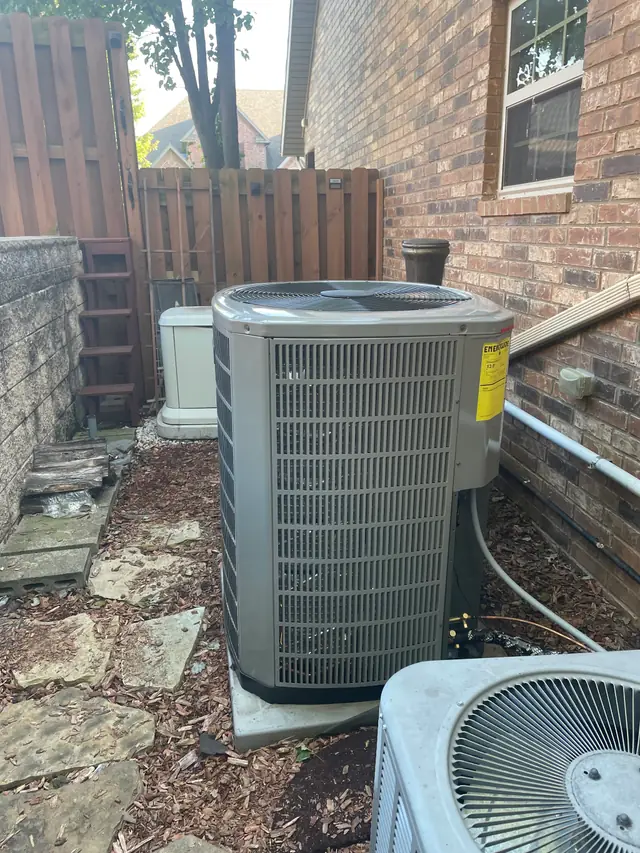
When the vents start blowing warm air in the middle of a Northwest Arkansas summer, it is tempting to assume the whole system is finished. Often it is something much smaller. Sometimes it is not. The useful skill is telling the two apart: which checks a homeowner can do safely in a few minutes, and which faults need a technician with the right tools. Here is the list, in the order worth working through.
Start at the thermostat
It sounds too simple to mention, but a thermostat left on Heat, or set a few degrees above the room temperature, will never start a cooling cycle. Confirm the mode says Cool and the target is below the current reading. Then look at the fan setting. On Auto, the fan runs only while the system is cooling. On On, the fan runs all the time and can push lukewarm air through the vents between cooling cycles, which feels like a fault even though nothing is wrong. If the display is blank or faint, fresh batteries are the first thing to try.
Three more checks that are safe to do yourself
- The air filter. A filter packed with dust restricts the air moving across the indoor coil. Slide it out and hold it up to a window. If you cannot see light through it, replace it.
- The breaker panel. An air conditioner usually has one breaker for the indoor unit and another for the outdoor unit. If either has tripped, reset it once. If it trips again, leave it off and call, because a repeat trip means something is drawing more current than it should.
- The outdoor unit. Walk out and look at the condenser. Leaves, grass clippings, cottonwood fluff, or shrubs crowding the cabinet keep it from shedding heat. Clear the space around it, and check that the fan on top is turning while the system runs.
After any of these, give the system a full cooling cycle before you judge the result. If the air is still warm, stop adjusting things and move on to the next section.
Signs that the problem is past the homeowner's checklist
Summit Heating and Air lists the common signs that an air conditioner needs repair: warm air blowing from the vents, poor airflow, moisture or leakage, unusual noises, higher energy bills, and a system that keeps cycling on and off. Ice on the refrigerant line, an outdoor unit that hums but will not start its fan, or a burning smell belong on that list too.
If you see any of them, turn the system off at the thermostat and call. Letting a struggling system run to see what happens is how a small repair turns into a large one.
What a technician checks, and the usual culprits
For a cooling call, Summit's diagnostic work covers four areas: electrical components, thermostat communication, airflow restrictions, and refrigerant-related issues. The areas overlap. A dirty filter can starve the coil of air, the coil can freeze, and a frozen coil looks a lot like a refrigerant problem until someone checks. The faults named on Summit's repair page make a good map:
- Failed capacitor. The capacitor gives the outdoor motors the jolt they need to start. When it fails, the fan or compressor may hum without starting, and the house slowly warms up.
- Frozen coil. Restricted airflow or a refrigerant problem can let the indoor coil ice over. Ice blocks the air from passing through, so the vents blow weakly and warm. Turning the system off and letting the ice melt is safe. Fixing whatever caused it is the technician's job.
- Clogged drain. The drain line carries away the moisture the coil pulls out of your air. When it clogs, water backs up, and many systems shut themselves off to protect the house.
- Refrigerant-related issues. Refrigerant is sealed in a closed loop, so a low level points to a leak. Finding it takes gauges and leak-detection tools, not a top-off and a hope.
Summit's technicians work on ranch homes, split-level houses, townhomes, and older properties, including jobs with attic equipment, tight utility closets, or aging components. An upstairs system that blows warm air can trace back to thermostat issues, restricted airflow, frozen coils, electrical failures, or low refrigerant, which is why a proper diagnosis comes before any repair.
When the house is already hot
Lisa B described exactly this in a Google review of Summit: "Our air conditioner stopped cooling and in these 100-degree temps it was sweltering. The owner, Brock, came out and checked out our unit and got it fixed quickly."
Timing matters once a house starts climbing, so call as soon as the problem is clear instead of waiting overnight. Summit offers 24/7 emergency service. For non-emergency visits, typical availability is within 2-3 business days.
If your system is still blowing warm air after the basic checks, call Summit Heating and Air at 479-234-4600 and ask about Summit's air conditioning service.
Summit Heating and Air, 479-234-4600
Call 479-234-4600More articles
Repair or Replace Your Air Conditioner: Five Signs That Decide It
One sign is a reason to ask questions; several together are a reason to get a replacement quote.
Spring and Fall HVAC Tune-Ups: What You Get and Why Twice a Year
A tune-up is a scheduled inspection, cleaning, and lubrication, timed to the two seasons your system works hardest.